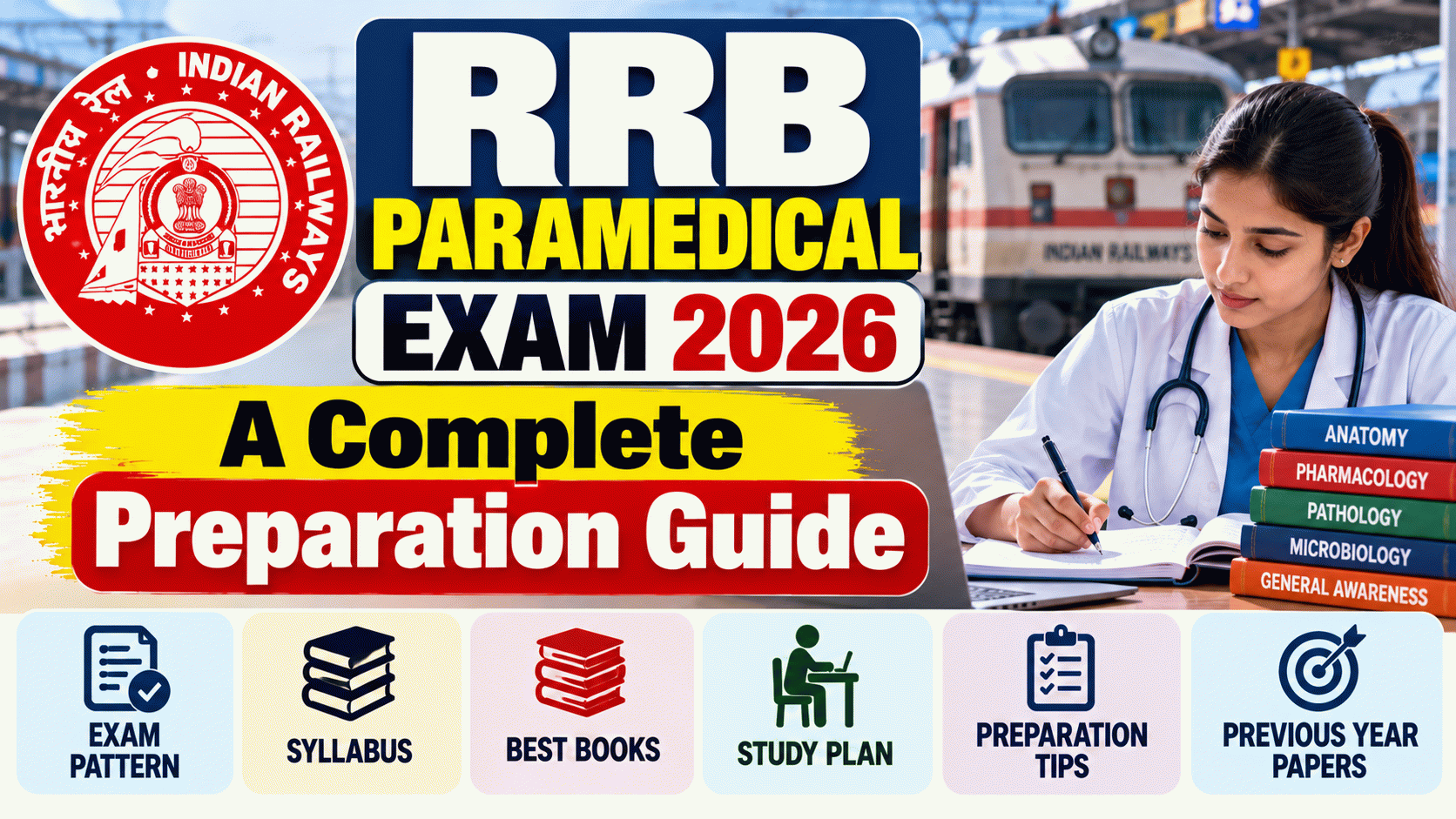
If you’re pursuing a paramedical qualification — B.Sc Nursing, D.Pharm/B.Pharm, DMLT, Radiography, or any allied health diploma — RRB Paramedical is one of the most reliable government job opportunities you can aim for. Indian Railways recruits for posts like Staff Nurse, Pharmacist, Lab Assistant/Technician, Radiographer, ECG Technician, Dialysis Technician, and Health/Malaria Inspector, all through this one Computer-Based Test. The pay is solid, the job is secure, and unlike many exams, more than half the paper is built around the subject you already studied in college. That’s a real advantage — if you prepare for it correctly.
Here’s how to go about it.
Understand the Exam Pattern First
The RRB Paramedical CBT has 100 questions for 100 marks, to be completed in 90 minutes, with negative marking of 1/3 mark for every wrong answer. The paper is divided into four sections:
- Professional Ability – 70 questions (subject-specific, based on your paramedical qualification)
- General Awareness – 10 questions
- General Arithmetic & Reasoning – 10 questions
- General Science – 10 questions
Notice the weightage: 70% of the paper is your own professional subject. This changes your entire preparation strategy compared to a general exam like SSC or bank PO — your college textbooks and clinical/lab knowledge matter more here than generic reasoning tricks.
Build Your Preparation Around This 70% Advantage
Most candidates make the mistake of treating this like any other competitive exam and spending equal time on all sections. Don’t. Since Professional Ability alone decides most of your score, structure your days around it first, and treat the remaining three sections as supporting subjects you brush up on alongside it.
- Daily: Revise one topic from your professional subject in depth (anatomy, pharmacology, microbiology, radiography technique, etc., depending on your post)
- Daily: 30–40 minutes on General Awareness and General Science together — these overlap a lot
- Alternate days: Arithmetic & Reasoning practice, since only 10 questions come from here
- Every few days: A full-length mock test, followed by reviewing every wrong answer
Section-by-Section: What to Study and From Where
Professional Ability (the section that decides your score)
This varies by the post you’re applying for, so pick books specific to your role rather than generic ones:
- For Lab Assistant/Technician: Textbook of Medical Laboratory Technology by Praful B. Godkar
- For Radiographer: Textbook of Radiographic Positioning and Techniques by Kenneth Bontrager, and Essentials of Radiologic Science by Robert Fosbinder
- For Staff Nurse/Nursing Superintendent: your B.Sc Nursing core textbooks — Anatomy & Physiology (Ross & Wilson), Fundamentals of Nursing, and Pharmacology notes are the real preparation here
- For Pharmacist: your D.Pharm/B.Pharm core subjects — Pharmacology, Pharmaceutics, and Pharmaceutical Chemistry notes/standard textbooks
- General paramedical MCQ practice books and previous year RRB Paramedical solved papers are useful across all posts for getting used to the question style
If you’re a recent graduate, this section should feel more like revision than new learning. If it’s been a while since college, budget extra time here — it’s worth it, since 70 of your 100 questions come from it.
General Awareness
- Lucent’s General Knowledge — covers static GK and current affairs well
- Manorama Yearbook — good for a broader current affairs sweep
- A short daily current affairs habit, with extra focus on railway-related news and government health schemes
General Arithmetic & Reasoning
- Quantitative Aptitude by R.S. Aggarwal — for the arithmetic basics (percentages, ratios, averages, simple/compound interest)
- A Modern Approach to Verbal & Non-Verbal Reasoning by R.S. Aggarwal — for the reasoning portion
Since this section is only 10 questions, don’t over-invest here. A week of focused practice on the basics is usually enough to secure most of these marks.
General Science
- NCERT Science textbooks, Class 6–10 — genuinely the best source for this section
- Lucent’s General Knowledge also has a solid general science section that overlaps well with this
Free YouTube Channels Worth Following
Since Professional Ability differs by post, the most useful channels are the ones that teach your specific subject rather than generic “RRB Paramedical” content:
- Testpaperlive Paramedical Classes — broad RRB Paramedical coverage with post-wise playlists
- Adda247 Nursing — useful for Staff Nurse/Nursing Superintendent aspirants
- MLT Education Point — focused on Lab Assistant/Medical Lab Technology MCQs
- PW Pharma / Pharmacy India — for Pharmacist post preparation
- Testbook or Parcham Classes — for the General Awareness and Reasoning portions common to most SSC/RRB-style exams
Pick one post-specific channel for your Professional Ability section, and one general channel for the common sections. That combination covers the full paper without wasting time on irrelevant content.
Why Mock Tests Matter Even More Here
With 70 questions from your own subject and only 90 minutes on the clock, time management is everything. A lot of candidates who know the subject well still lose marks simply because they spend too long on a handful of tricky professional questions and rush the last section. Mock tests are how you find that rhythm before it costs you marks on the actual exam day.
With 1/3 negative marking, guessing on professional questions you’re genuinely unsure about can hurt more than it helps — mock practice is what teaches you to recognize the difference between an educated guess and a blind one.
Put your preparation to the test with a full-length, exam-accurate mock test — 100 questions matching the real section-wise pattern, 90-minute timer, 1/3 negative marking, and a detailed review at the end so you know exactly where you’re losing marks. Take the Free RRB Paramedical Mock Test →
A Realistic Timeline
If your professional subject is fresh from college, 2–3 months of focused revision plus regular mock tests can get you exam-ready. If you graduated a while back, give yourself 4–5 months so you have enough time to properly revisit your core subject alongside the general sections. Either way, start taking mock tests early — they’ll tell you which of your “known” topics actually need more work.
Your professional degree already did most of the heavy lifting for this exam. The job now is discipline: revise consistently, take the general sections seriously even though they’re small, and practice under real exam conditions often enough that the 90-minute timer stops feeling like the enemy.