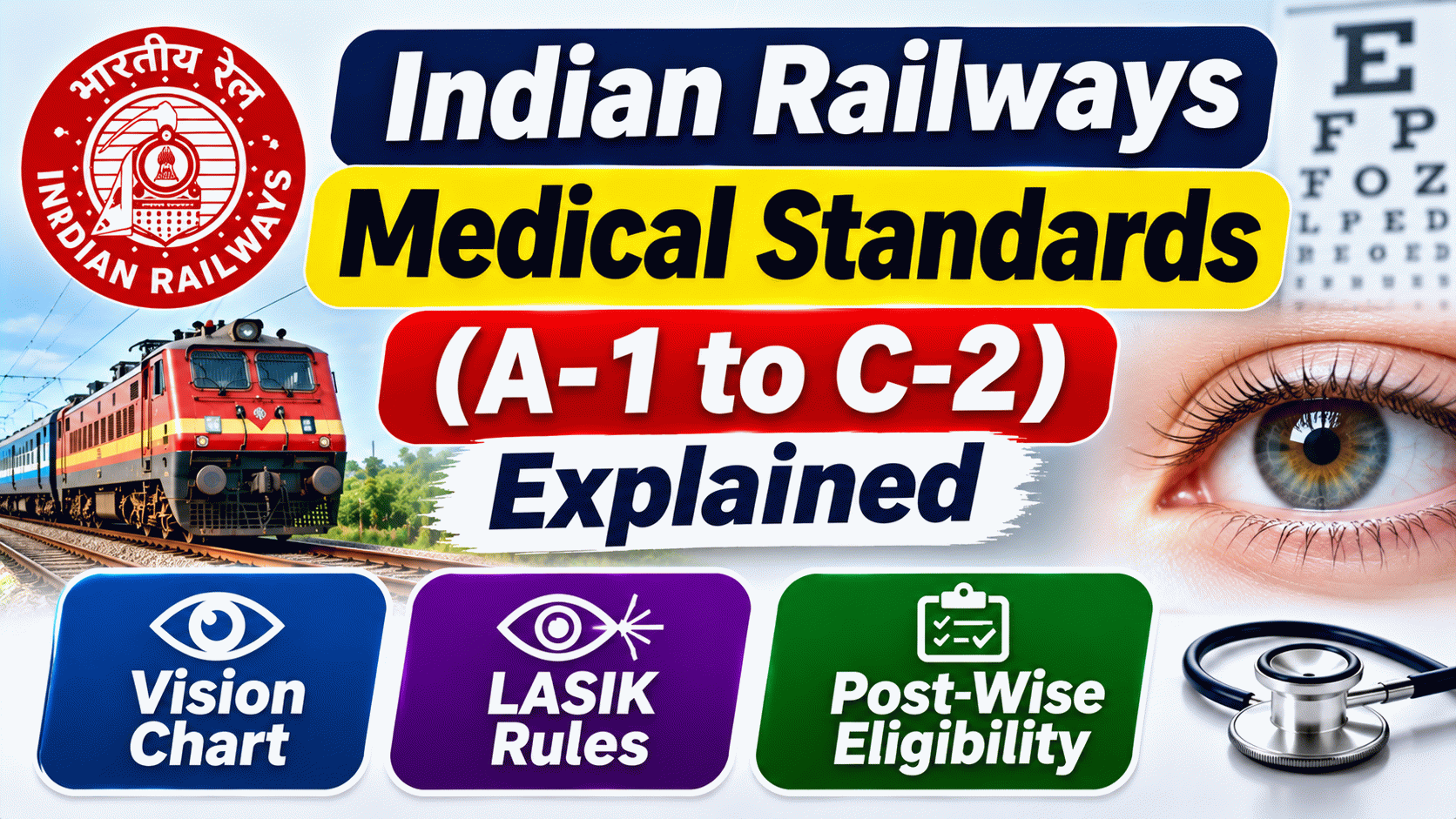
Every year, thousands of high-scoring candidates clear the Computer Based Tests (CBT) for RRB NTPC, ALP, Technician, JE, and Group D, only to face permanent disqualification during the final Document Verification and Medical Examination stage. Unlike standard civil service exams, Indian Railways enforces strict medical classifications governed by the Indian Railway Medical Manual (IRMM) because train operations directly impact public safety. Before paying your application fee or locking in your post preferences on the RRB portal, use this comprehensive guide to verify which medical category matches your eyesight and physical fitness.
Why Your Post Preference Order Must Match Your Eyesight
When you fill out an online application for multi-post notifications (such as RRB NTPC, RRB JE, or RRB Technician), the portal asks you to rank posts in order of preference. If you score high enough in the CBT to be allotted your first preference—for example, Station Master (A-2 Medical Standard)—the Railway Board will send you for an A-2 medical test.
The Single-Allotment Trap: Under recent Railway Recruitment Board norms, candidates are called for Document Verification in a 1:1 ratio against a specific post. If you fail the medical standard required for your allotted post, Indian Railways will not automatically downgrade or reallocate you to a lower medical category post (such as Junior Clerk with C-2 medical), even if your marks are above that post’s cut-off. Understanding your exact vision category before submitting your form is your only protection against disqualification.
Complete Railway Medical Standards Chart (A-1 to C-2)
Indian Railways divides medical fitness into seven distinct categories based on how closely a post is tied to running trains, reading track signals, and public safety. Category A-1 is the strictest, while C-2 is the most relaxed.
| Medical Category | Distant Vision Requirement | Near Vision (Snellen) | Glasses & Max Power Allowed | Mandatory Additional Vision Tests |
|---|---|---|---|---|
| A-1 | 6/6, 6/6 | Sn 0.6, 0.6 | Strictly NOT Allowed (Must pass +2D Fogging Test) | Colour Vision, Binocular Vision, Night Vision, Mesopic Vision & Field of Vision |
| A-2 | 6/9, 6/9 | Sn 0.6, 0.6 | Strictly NOT Allowed (No Fogging Test required) | Colour Vision, Binocular Vision, Night Vision & Mesopic Vision |
| A-3 | 6/9, 6/9 | Sn 0.6, 0.6 | Allowed (Max lens power up to 2 Dioptres) | Colour Vision, Binocular Vision, Night Vision & Mesopic Vision |
| B-1 | 6/9, 6/12 | Sn 0.6, 0.6 | Allowed (Max lens power up to 4 Dioptres) | Colour Vision, Binocular Vision, Night Vision & Mesopic Vision |
| B-2 | 6/9, 6/12 | Sn 0.6, 0.6 | Allowed (Max lens power up to 4 Dioptres) | Binocular Vision & Field of Vision (Colour Vision NOT required) |
| C-1 | 6/12, 6/18 | Sn 0.6, 0.6 | Allowed (With or without glasses; no 4D cap) | General eye health for close office/technical work |
| C-2 | 6/12, Nil (One eye) | Sn 0.6 (Combined) | Allowed (With or without glasses) | Basic visual acuity for clerical and ministerial work |
Post-Wise Medical Category Mapping Across Major RRB Exams
Use this reference table to identify which medical category applies to your target post across Indian Railways recruitment drives:
| RRB Exam / Cadre | Post Name | Required Medical Standard |
|---|---|---|
| RRB ALP | Assistant Loco Pilot (Train Driver) | A-1 |
| RRB NTPC / CEN 08 | Station Master | A-2 |
| RRB NTPC Graduate | Goods Train Manager (formerly Goods Guard) | A-2 |
| RRB NTPC UG | Trains Clerk | A-3 |
| RRB JE | Junior Engineer (P-Way, Bridge, Works, S&T, Electrical) | A-3 |
| RRB Technician | Technician Grade-I Signal & Select Grade-III Trades | B-1 |
| RRB Group D (Level-1) | Track Maintainer Grade-IV, Pointsman, Assistant S&T | A-2 to B-1 (Post-dependent) |
| RRB NTPC (Grad & UG) | Chief Commercial cum Ticket Supervisor (CCTS) & Commercial cum Ticket Clerk | B-2 |
| RRB Paramedical | Staff Nurse, Pharmacist, Radiographer, Lab Assistant, Health Inspector | B-1 to C-2 (Post-dependent) |
| RRB NTPC (Grad & UG) | Junior Account Assistant (JAA), Senior Clerk, Junior Clerk & Accounts Clerk | C-2 |
Critical Ophthalmic Tests & Disqualification Rules Explained
1. The LASIK & Refractive Surgery Ban (A-1, A-2, A-3 & B-1)
Many candidates assume they can undergo LASIK, SMILE, PRK, or ICL (Implantable Collamer Lens) surgery to remove their spectacles and qualify for Assistant Loco Pilot (A-1) or Station Master (A-2). Indian Railways strictly prohibits any form of corneal or refractive surgery for A-1, A-2, A-3, and B-1 medical categories.
During the railway medical exam, ophthalmic specialists examine your cornea using a Slit-Lamp Biomicroscope and Corneal Topography, which immediately detect surgical flaps or laser reshaping regardless of how many years ago the procedure was performed. Candidates with a history of LASIK should strictly prioritize B-2, C-1, and C-2 posts (subject to residual fundus and retinal health).
2. What is the “+2D Fogging Test” in Category A-1?
In the A-1 category (Assistant Loco Pilot), having 6/6 naked-eye vision is not enough. Railway doctors administer a +2 Dioptre Fogging Test to check for latent hypermetropia (farsightedness that young eyes temporarily compensate for by straining the ciliary muscles). During the test, a +2D convex lens is placed in front of your eyes while reading the Snellen chart. If you can still read the distant lines clearly through the +2D lens, it proves your eyes have hypermetropic error exceeding +2D, resulting in disqualification from A-1.
3. Colour Blindness: Ishihara Plates & The Lantern Test
Operational railway staff must distinguish red, yellow, and green signals instantaneously in fog, rain, and darkness. For all posts under A-1, A-2, A-3, and B-1, candidates undergo two colour perception checks:
- Ishihara Chart Test: Reading numbers and tracing paths embedded inside dotted colour plates.
- Edridge-Green Lantern Test: Identifying small coloured light apertures of varying brightness in a dark room to simulate distant railway signals at night.
Strategic Tip for Colour-Blind Candidates: Even mild red-green colour deficiency (Protanopia or Deuteranopia) is an absolute disqualifier for A-1 through B-1 posts. However, Category B-2, C-1, and C-2 posts do NOT require normal colour vision. If you have colour vision deficiency, place Commercial cum Ticket Clerk (B-2), CCTS (B-2), and Clerk/Typist (C-2) at the top of your preference list.
4. Binocular Vision, Night Vision & Mesopic Vision
- Binocular Vision & Squint (Strabismus): Both eyes must focus on the same object simultaneously to judge depth and speed accurately. Presence of squint or lack of stereoscopic fusion disqualifies candidates from A-1 to B-2 categories.
- Night & Mesopic Vision: Evaluates how fast your retina adapts from bright light (such as oncoming locomotive headlights) back to low-light conditions.
General Physical Health Checks Beyond Eyesight
Regardless of whether you are undergoing an A-1 or C-2 checkup, the Railway Medical Board conducts a complete systemic examination:
- Blood Pressure & Diabetes: Fasting and Post-Prandial (PP) blood sugar tests alongside ECG and BP checks. Uncontrolled hypertension or diabetes can stall your medical clearance until stabilized.
- Hearing Acuity: Tested via Pure Tone Audiometry and conversational voice checks to ensure you can hear operational alarms and whistles.
- Hydrocele, Hernia & Piles: Surgical conditions such as inguinal hernia, hydrocele, or severe varicose veins result in a “Temporarily Unfit” status. Candidates are typically granted a grace window to get the condition surgically corrected and return for re-examination.
How to File a Medical Appeal if Declared “Unfit”
If the initial Three-Member Railway Medical Committee declares you medically unfit for your allotted post, your journey is not necessarily over. Indian Railways provides a formal Medical Appeal mechanism:
- Obtain the Unfit Memo: Collect the formal written communication detailing the exact medical parameters on which you were declared unfit.
- Get an Independent Specialist Certificate: Within 30 days of receiving the unfit memo, get yourself examined by a Government or Private Ophthalmologist/Specialist. The doctor must explicitly mention in the certificate that they are “fully aware of the specific Indian Railway medical standards for the post and have examined the candidate against those exact parameters.”
- Submit the ₹1,000 Appeal Demand Draft: Submit your appeal application to the Chief Medical Director (CMD) of the respective Railway Zone through the RRB Chairman, accompanied by a Demand Draft (DD) of ₹1,000 drawn in favor of the designated Financial Adviser & Chief Accounts Officer (FA&CAO).
- Appellate Medical Board Decision: If the CMD accepts your appeal, you will be re-examined by a senior Appellate Medical Board. If the Appellate Board finds you fit, your ₹1,000 DD is refunded.
Pre-Medical Checklist: 5 Steps Before Your Exam Day
- Get a Pre-Application Eye Checkup: Visit an optometrist before filling out your RRB form and ask for your uncorrected distant vision, spherical/cylindrical power in Dioptres, and an Ishihara colour chart test.
- Carry Current Spectacles & Prescription: If you are applying for A-3, B-1, B-2, C-1, or C-2 posts and wear glasses, carry two pairs of plain (non-photochromic, non-tinted) spectacles matching your exact current prescription to the medical hospital.
- Rest Your Eyes for 48 Hours: Avoid smartphone and computer screen strain for 48 hours prior to your medical date; ciliary muscle spasm from prolonged screen time can temporarily worsen distant vision from 6/6 to 6/9.
- Clean Earwax in Advance: Impacted earwax (cerumen) is a common avoidable cause of failing the whispering/audiometry hearing test. Have an ENT doctor inspect your ears a week before Document Verification.
- Fast Properly: Report to the railway hospital on an empty stomach (8–10 hours of overnight water-only fasting) so your blood sugar and lipid readings remain accurate.
Frequently Asked Questions
Q1. How do I calculate whether my spectacle power is within the 2D (A-3) or 4D (B-1/B-2) limit?
Railway medical boards calculate total lens power by taking the algebraic sum of your Spherical (SPH) and Cylindrical (CYL) powers in a single eye. For example, if your eye has -2.50 SPH and -1.00 CYL, your total power is 3.50 Dioptres, making you ineligible for A-3 (max 2D) but eligible for B-1 and B-2 (max 4D).
Q2. Are photochromic (day-night colour-changing) glasses allowed during the railway medical test?
No. Indian Railways only permits clear, non-tinted, plain corrective lenses during the medical examination and on duty.
Q3. Can a candidate with one functional eye get a job in Indian Railways?
Yes, under the C-2 medical category (distant vision of 6/12 in one eye and nil in the other, with Sn 0.6 near vision) and under designated Persons with Benchmark Disabilities (PwBD – Low Vision/One Eye) reserved quotas.
Q4. Does LASIK surgery disqualify me from Junior Clerk or Commercial cum Ticket Clerk posts?
While LASIK is strictly barred for A-1, A-2, A-3, and B-1 safety categories, candidates who have undergone refractive surgery without any retinal complications or progressive myopia are generally eligible for C-1 and C-2 clerical categories (and B-2 subject to specific CEN guidelines on axial length and corneal thickness).