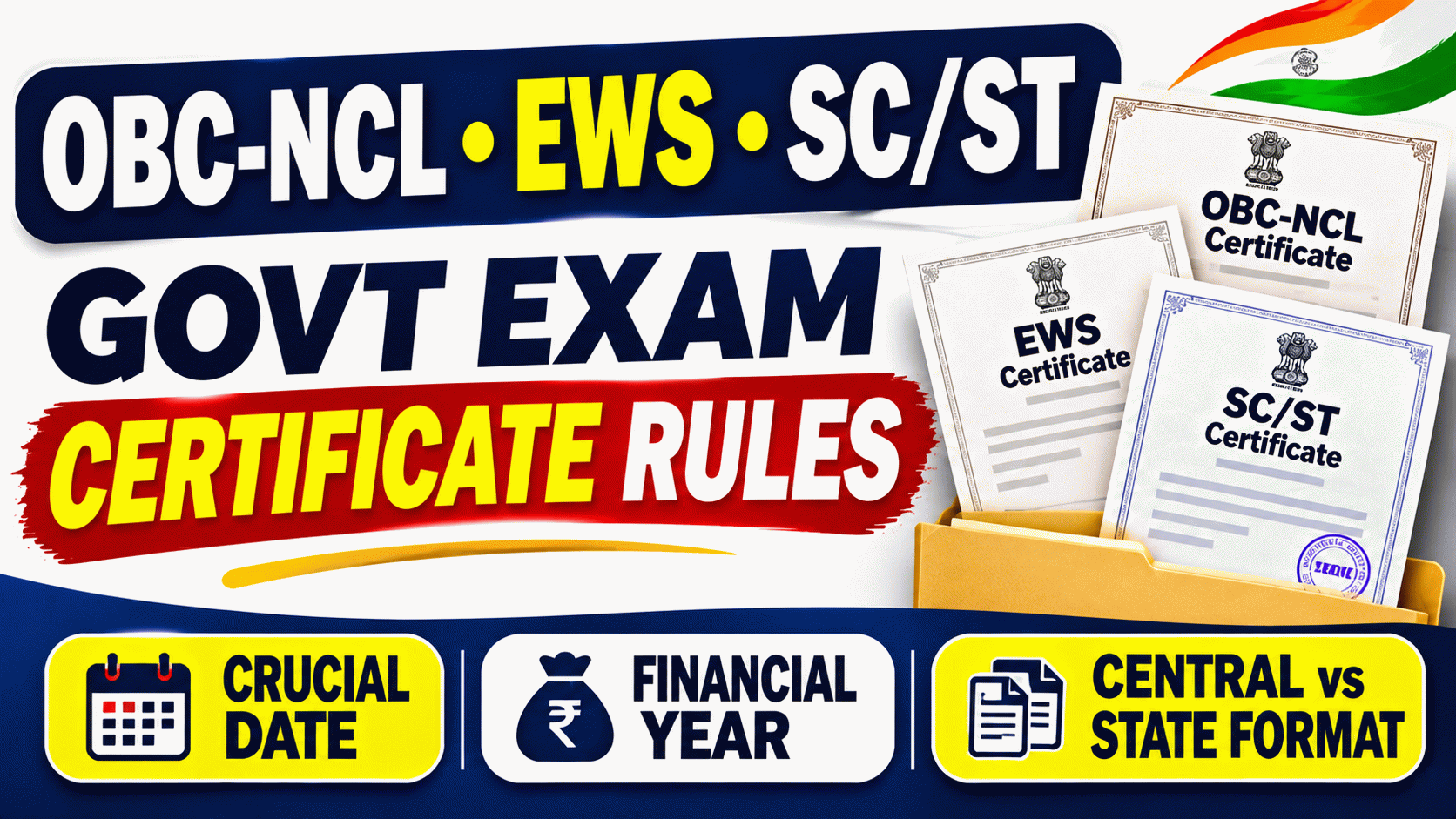
Every recruitment season, thousands of deserving candidates who clear the written cut-offs in SSC CGL, RRB NTPC, UPSC, IBPS, and State PSC exams have their candidatures cancelled—or get shifted to the Unreserved (General) category—during Document Verification (DV). In over 80% of cases, the rejection happens not because the candidate is ineligible, but because their OBC (Non-Creamy Layer) or EWS (Economically Weaker Section) certificate was issued in the wrong format, calculated on the wrong financial year, or dated after the notification’s “Crucial Date.” This complete reference guide breaks down DoPT rules so your reservation certificate passes Document Verification on the first attempt.
Master Comparison: SC/ST vs. OBC-NCL vs. EWS Certificates
Because SC/ST reservation is based strictly on social status by birth while OBC-NCL and EWS reservations are tied to dynamic annual income thresholds, their validity rules are completely different:
| Rule / Parameter | SC / ST Certificate | OBC-NCL Certificate | EWS Certificate |
|---|---|---|---|
| Validity Duration | Lifetime (Permanent validity unless caste list changes) | 1 Financial Year (1 April to 31 March) | 1 Financial Year (1 April to 31 March) |
| Annual Income Limit | No Income Limit (for exam reservation) | Below ₹8.00 Lakh per annum | Below ₹8.00 Lakh per annum |
| Income Assessment Window | Not Applicable | 3 Preceding Consecutive Financial Years | 1 Single Preceding Financial Year |
| Salary & Agriculture Income | Not Applicable | Parents’ Salary & Agricultural income are EXCLUDED from the ₹8L limit | All sources (Salary, Agriculture, Business & Profession) are INCLUDED |
| Property / Asset Limits | None | Agricultural land ceilings as per Creamy Layer schedule | Strict 4-Point Asset Test (Flat/Plot/Agri Land caps) |
| Minimum Issuing Authority | Tehsildar / SDM / SDO / District Magistrate | Tehsildar / Naib Tehsildar (and above) | Tehsildar / Naib Tehsildar (and above) |
1. OBC (Non-Creamy Layer) Rules: The ₹8 Lakh & 3-Year Formula
To claim the 27% OBC reservation in Central Government jobs and institutions, belonging to a backward caste is only step one. You must satisfy two separate conditions simultaneously:
- Central List Inclusion: Your specific community/sub-caste must be listed in the Central List of OBCs maintained by the National Commission for Backward Classes (NCBC) for your state. Many castes are notified in a State’s OBC list (for state exams) but are not in the Central OBC list. If your caste is only in the State list, you must apply as an Unreserved (UR) candidate in Central exams (SSC, RRB, UPSC, Banking, PSUs).
- Non-Creamy Layer (NCL) Status: Your parents’ annual “Other Income” must not have reached or exceeded ₹8,00,000 per annum for three consecutive preceding financial years.
The Most Misunderstood OBC Rule: Parents’ Salary & Agricultural Income
Under the landmark DoPT Office Memorandum No. 36033/5/2004-Estt.(Res.), a candidate’s OBC Creamy Layer status is determined exclusively by their parents’ status and income (never the candidate’s own salary or their spouse’s salary). Furthermore, when calculating the ₹8 Lakh limit:
- If neither parent is a direct Class-I / Group-A officer (or promoted to Class-I before age 40, or both parents in Class-II), their government/private salary income and agricultural income are NOT clubbed with income from other sources.
- Only parental income from “Other Sources” (such as business, shop, rent, consultancy, or capital investments) must remain below ₹8 Lakh across three consecutive financial years.
2. EWS (Economically Weaker Section) Rules: Income + The 4-Point Asset Test
Introduced under the 103rd Constitutional Amendment, the 10% EWS quota is strictly available to candidates who do not belong to SC, ST, or OBC (Central/State) categories. Unlike OBC-NCL, EWS eligibility is significantly stricter on how family income is counted:
- Definition of “Family” in EWS: Includes the candidate, the candidate’s parents, siblings below the age of 18 years, and the candidate’s spouse and children below 18 years.
- Gross Annual Income Below ₹8 Lakh: Total family income from ALL sources combined—including Salary, Agriculture, Business, and Profession—for the single financial year prior to the year of application must be less than ₹8,00,000.
The Mandatory 4-Point Property Exclusion Test
Even if your family’s gross income is ₹2 Lakh per year, your family will be disqualified from EWS if they own or possess any one of the following four assets anywhere in India (combining properties across different locations):
- 5 Acres or more of agricultural land; OR
- A residential flat of 1,000 sq. ft. or above; OR
- A residential plot of 100 sq. yards or above in notified municipalities; OR
- A residential plot of 200 sq. yards or above in areas other than notified municipalities.
The “Crucial Date” & Financial Year Calculation Rule
Almost every central recruitment notification (UPSC, SSC, RRB, IBPS, PSU) specifies that the Closing Date of Receipt of Online Application is the Crucial Date for determining eligibility. Both EWS and OBC-NCL certificates are valid for one financial year running from 1 April to 31 March.
| If Exam Notification / Closing Date Falls Between: | Valid Certificate Issue Window | Required Financial Year (FY) of Income Assessment |
|---|---|---|
| 01 April 2026 to 31 March 2027 | Issued on or after 01 April 2026 (up to Closing Date) | EWS: Based on FY 2025–26 Income OBC-NCL: Based on FY 2025–26, 2024–25 & 2023–24 |
| 01 April 2027 to 31 March 2028 | Issued on or after 01 April 2027 (up to Closing Date) | EWS: Based on FY 2026–27 Income OBC-NCL: Based on FY 2026–27, 2025–26 & 2024–25 |
Why EWS Rejections Are Stricter Than OBC: In several recent verification drives, commissions have occasionally accepted older/newer OBC-NCL certificates as provisional if accompanied by a valid financial-year affidavit, whereas an EWS Income & Asset Certificate issued after the closing date or for the wrong Financial Year is almost universally rejected (converting the candidate to General category if they meet the UR age and cut-off criteria). Always renew your EWS and OBC-NCL certificates in April every year.
The Out-of-State & Marriage Domicile Traps
- Applying in Another State’s PSC/Subordinate Exam: Reservation for SC, ST, OBC, and EWS in State Government exams (such as UPPSC, BPSC, RPSC, MPPSC, or MPSC) is restricted exclusively to permanent domicile residents of that specific state. If you hold an OBC/SC/ST certificate from Rajasthan and apply for a UPPSC or Bihar exam, you must select the Unreserved (General) category.
- The Delhi (DSSSB) Special Rule: In Delhi Government / DSSSB exams, SC and ST candidates from all over India are eligible for reservation, but OBC reservation is strictly restricted to OBC (Delhi) candidates whose family has resided in Delhi since before 1993.
- Married Women’s Caste/OBC Certificate Rule: A woman’s caste and Non-Creamy Layer status are determined strictly by her biological parents’ caste and parental income—never by her husband’s caste or husband’s income. Even after marriage, a female candidate must obtain her SC/ST/OBC-NCL certificate based on her father’s residential records and parental income. (For EWS, however, a married woman’s spouse is included in the “Family” definition).
Pre-Verification Document Checklist
- Check the Header Text: Ensure your OBC-NCL certificate carries the exact central header: “Form of Certificate to be Produced by Other Backward Classes Applying for Appointment to Posts Under the Government of India” and cites the exact NCBC Resolution Number under which your caste is notified.
- Verify the Seal & Designation: Certificates signed only by a Sarpanch, Ward Councillor, Patwari, or Lekhpal are invalid. The certificate must bear the round seal or verified digital signature of a Revenue Officer not below the rank of Tehsildar / Naib Tehsildar / SDM.
- Check Dual Financial Year Wording on EWS: An EWS certificate issued in May 2026 must explicitly say “VALID FOR THE YEAR 2026-2027” at the top and mention that gross family income is below ₹8 Lakh for the preceding “Financial Year 2025-2026.” If both spaces carry the same year by clerical mistake, get it corrected at the Tehsil office immediately.
Frequently Asked Questions
Q1. My digitally signed e-District OBC/EWS certificate does not have a wet ink stamp. Is it valid for RRB and SSC Document Verification?
Yes, digitally signed certificates carrying a verifiable QR code or unique application barcode issued through official state e-District portals are valid. However, for Railway (RRB) and Bank exams that specify a custom Annexure format in their notification PDF, it is safest to also get the notification’s exact Annexure format counter-signed by your Tehsildar.
Q2. I earn ₹9 Lakh per year in a private IT job, while my retired parents have zero business income. Am I eligible for OBC-NCL?
Yes. Under DoPT rules for OBC Creamy Layer determination, a candidate’s own salary income is never counted—only the biological parents’ status and parental non-salary/non-agricultural income are evaluated.
Q3. Can I change my category from EWS/OBC to General during Document Verification if my certificate has an error?
If your certificate is found invalid during Document Verification, your candidature is considered under the Unreserved (General) category only if you did not avail any category-based relaxation in age limit, physical standards, number of attempts, or prelims/written qualifying cut-off marks.
Q4. Do SC and ST candidates need to renew their caste certificate every financial year?
No. Unlike OBC-NCL and EWS certificates, an SC or ST certificate issued in the prescribed Central/State format by a competent authority (Tehsildar/SDM/DM) has permanent validity and does not require annual renewal.