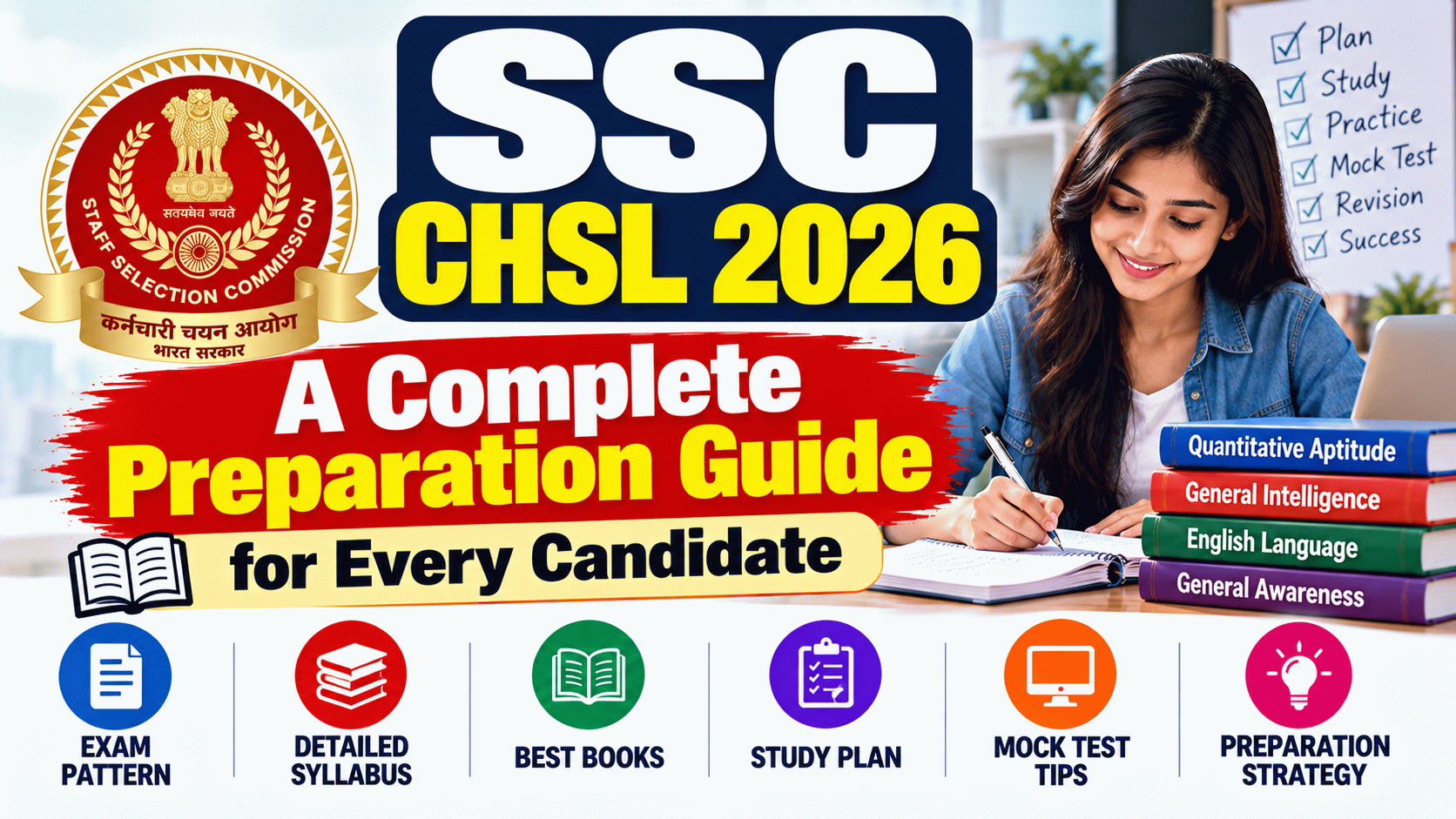
If you’re a 12th-pass student wondering which government exam to target first, SSC CHSL deserves a serious look. It’s one of the most accessible entry points into central government jobs — positions like Lower Division Clerk (LDC), Junior Secretariat Assistant (JSA), Postal Assistant, and Data Entry Operator all come through this one exam. No degree required, decent salary, job security, and a syllabus that rewards consistent effort more than raw genius. In other words, it’s winnable — if you prepare the right way.
Let’s break down exactly how.
First, Understand What You’re Up Against
SSC CHSL Tier-1 is a 60-minute, 100-question computer-based test worth 200 marks, split equally across four sections:
- General Intelligence & Reasoning – 25 questions
- General Awareness – 25 questions
- Quantitative Aptitude – 25 questions
- English Language – 25 questions
Each correct answer gets you 2 marks; each wrong one costs you 0.5. Skipped questions cost nothing. That single rule should shape your entire exam-day strategy — more on that later.
Tier-2 comes after you clear Tier-1, and it’s heavier — Mathematical Ability, Reasoning, English & Comprehension, General Awareness, and a Computer Knowledge module, followed by a typing/skill test depending on the post you’re eligible for. But don’t worry about Tier-2 on day one. Nail the fundamentals for Tier-1 first; a lot of that preparation carries forward anyway.
Build a Routine You Can Actually Stick To
Most people fail not because the syllabus is impossible, but because their prep is scattered — a bit of reasoning today, random GK video tomorrow, no revision at all. Structure beats intensity here. A simple daily split that works well:
- Morning: General Awareness (current affairs + static GK) and Quantitative Aptitude
- Afternoon: English grammar and vocabulary, plus Reasoning practice
- Evening: One full mock test or sectional test, followed by honest review of your mistakes
The evening mock-and-review habit is non-negotiable. Reading theory feels productive, but it’s solving questions under time pressure — and then actually studying why you got something wrong — that moves your score.
Section-by-Section: What to Study and From Where
Quantitative Aptitude
This section rewards practice over theory. Get your basics right first (percentages, ratios, averages, profit-loss, time-speed-distance), then move to speed-building.
- Fast Track Objective Arithmetic by Rajesh Verma
- Quantitative Aptitude by R.S. Aggarwal
- Magical Book on Quicker Maths by M. Tyra (great for calculation shortcuts)
If your basics are genuinely weak, spend a week with NCERT Maths (Class 6–10) before jumping to these — it saves a lot of frustration later.
General Intelligence & Reasoning
Mostly pattern recognition. The more puzzles you solve, the faster your brain spots the trick.
- A Modern Approach to Verbal & Non-Verbal Reasoning by R.S. Aggarwal
- Analytical Reasoning by M.K. Pandey
English Language
This is the section candidates most often neglect, and it’s the easiest to score high in with steady daily practice.
- Objective General English by S.P. Bakshi
- From Plinth to Paramount by Neetu Singh
- Word Power Made Easy by Norman Lewis (for vocabulary — don’t cram it, read a few pages daily)
Reading a newspaper like The Hindu or Indian Express for 15–20 minutes a day quietly upgrades your comprehension and vocabulary without it feeling like “studying.”
General Awareness
The one section you can’t cram in the last month. Start early.
- Lucent’s General Knowledge — still the most trusted single book for this section
- NCERT textbooks (Class 6–10, History/Geography/Polity/Science) for concept clarity
- A daily current affairs habit (even 10 minutes) matters more than any one book
Free YouTube Channels Worth Your Time
You genuinely don’t need to spend money to prepare well for CHSL — the free content available today is better than a lot of paid coaching from a few years ago. A few channels consistently recommended by aspirants who’ve actually cleared the exam:
- Wifistudy — one of the most complete free channels for SSC exams, strong on all four sections
- Study IQ — especially good for General Awareness and current affairs
- Adda247 — structured courses, daily quizzes, and test-taking strategy sessions
- SSC Wallah — dedicated SSC-focused content with regular live classes
- Abhinay Maths (Abhinay Sharma) — if quant is your weak spot, his shortcut-based teaching style is worth following
Pick one main channel per subject and stick with it. Channel-hopping wastes more time than it saves — consistency with one teacher’s method beats sampling five different approaches.
Why Mock Tests Matter More Than People Realize
Here’s something most aspirants underestimate: knowing the syllabus and performing under a 60-minute timer with negative marking hanging over your head are two very different skills. Mock tests teach you three things books can’t — where you’re losing time, which questions to skip instead of guessing, and how your accuracy holds up under pressure.
Given the negative marking rule (−0.5 per wrong answer), guessing blindly can actually hurt your score more than leaving a question blank. Mock tests are how you build the instinct to tell the difference between “I’m not sure” and “I genuinely don’t know” — a skill that only comes from repeated practice under real exam conditions.
Put everything above into practice with a full-length, exam-accurate mock test — 100 questions, the exact 4-section pattern, real negative marking, a live timer, and a detailed section-wise review at the end. Take the Free SSC CHSL Mock Test →
Make it a habit: one full mock every few days once you’ve covered the basics, then review every wrong answer like it’s the most important part of your study session — because it is.
A Realistic Timeline
If you’re starting from scratch, 4–6 months of focused daily preparation is a reasonable target for Tier-1. If you’re revising after already having a base, 2–3 months of concentrated mock-and-review practice can get you exam-ready. Either way, don’t wait for the “perfect” moment to start taking mock tests — start early, even when you feel unprepared. That discomfort is exactly what tells you what to study next.
SSC CHSL isn’t about being the smartest person in the room. It’s about being the most consistent one. Show up daily, track your mistakes, trust the process — and the result takes care of itself.