Almost every Central Government, Railway, Defence, and State Government recruitment notification lists salary in technical terms such as “Pay Level-6 (₹35,400 – ₹1,12,400) in the 7th CPC Pay Matrix.” For most job aspirants, translating that single Basic Pay figure into the actual monthly In-Hand (Net) Salary credited to your bank account is confusing. This complete reference guide breaks down the 7th Central Pay Commission (CPC) Pay Matrix from Level 1 to Level 10, explains how Dearness Allowance (DA), House Rent Allowance (HRA), and Transport Allowance (TA) multiply your earnings, and shows you step-by-step how to calculate your exact take-home pay.
How the 7th CPC Pay Matrix Replaced the Old Grade Pay System
Under the earlier 6th Pay Commission, government salaries were split into wide “Pay Bands” (PB-1 to PB-4) plus a separate “Grade Pay” (such as ₹1,800 GP or ₹4,600 GP). The 7th Central Pay Commission abolished separate Grade Pays and merged them into a unified, transparent 18-Level Pay Matrix using a uniform Fitment Factor of 2.57.
- Horizontal Rows (Pay Levels 1 to 18): Represent your hierarchy and status in government service. Moving horizontally from one Level to the next happens only when you receive a Promotion or MACP (Modified Assured Career Progression) financial upgradation after 10, 20, and 30 years of service.
- Vertical Columns (Cells 1 to 40): Represent your annual progression within the same Pay Level. Every year (either on 1 January or 1 July, depending on your joining/promotion date), you move down one Cell, receiving a compound 3% Annual Increment on your Basic Pay.
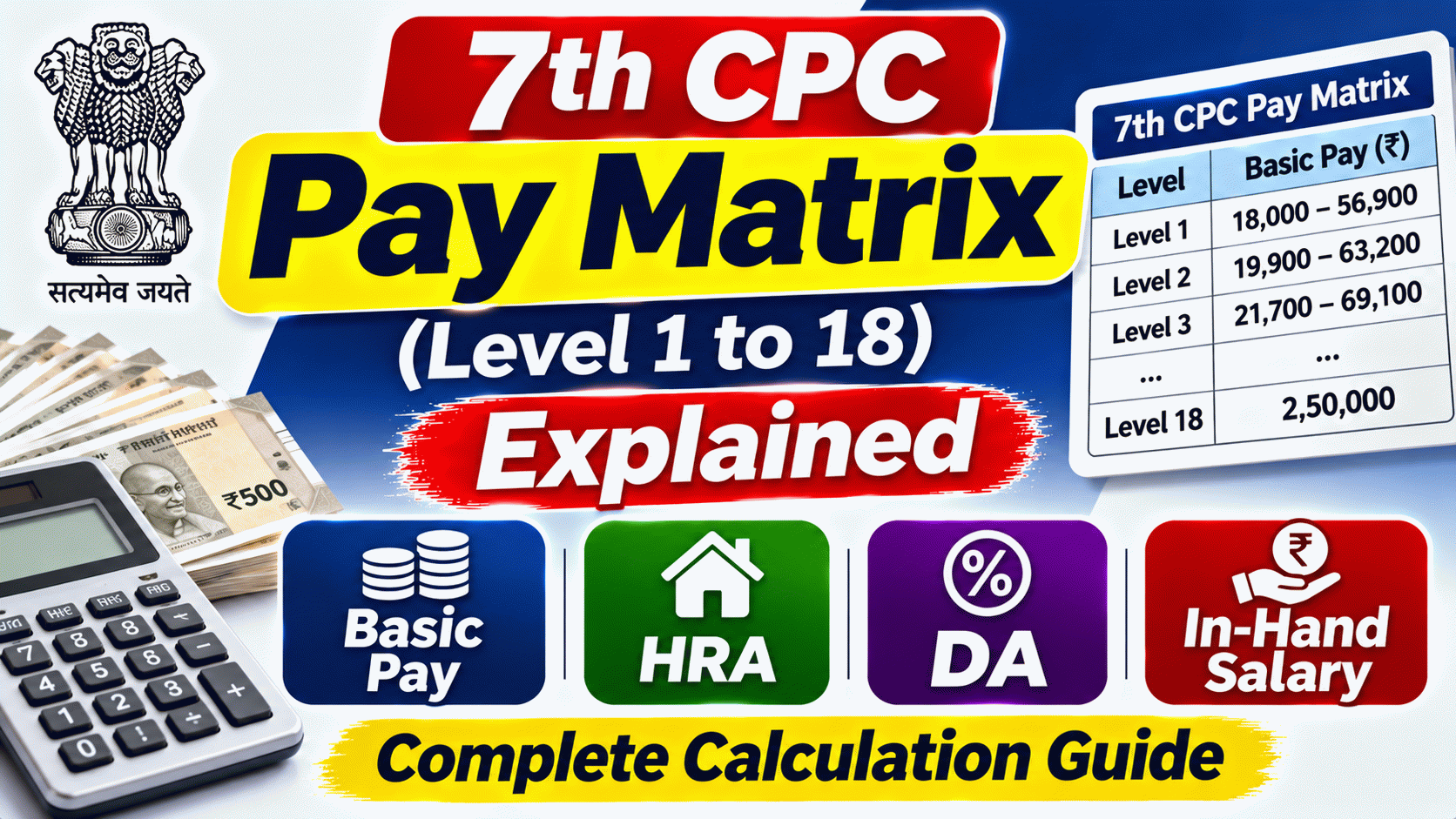
7th CPC Pay Matrix Chart (Level 1 to Level 10) & Major Govt Posts
The table below maps the first 10 Civilian Pay Levels against their old 6th CPC Grade Pay equivalents, entry-level Basic Pay (Cell-1), maximum Basic Pay, and the popular competitive exam posts that fall under each level:
| 7th CPC Pay Level | Old Grade Pay (6th CPC) | Entry Basic Pay (Cell-1) | Max Basic Pay in Level | Major Central & Railway Posts in This Level |
|---|---|---|---|---|
| Level 1 | ₹1,800 | ₹18,000 | ₹56,900 | SSC MTS, RRB Group D (Track Maintainer, Pointsman, Assistant) |
| Level 2 | ₹1,900 | ₹19,900 | ₹63,200 | SSC CHSL LDC/JSA, RRB ALP, RRB Junior Clerk cum Typist, Trains Clerk |
| Level 3 | ₹2,000 | ₹21,700 | ₹69,100 | SSC GD Constable, RRB Commercial cum Ticket Clerk, Delhi Court Peon |
| Level 4 | ₹2,400 | ₹25,500 | ₹81,100 | SSC CGL Tax Assistant (CBIC/CBDT), Postal Assistant / Sorting Assistant |
| Level 5 | ₹2,800 | ₹29,200 | ₹92,300 | RRB Goods Train Manager, Senior Clerk, Pharmacist, Auditor (CAG/CGDA) |
| Level 6 | ₹4,200 | ₹35,400 | ₹1,12,400 | SSC CPO Sub-Inspector, RRB JE, Station Master, CCTS, Supreme Court JCA |
| Level 7 | ₹4,600 | ₹44,900 | ₹1,42,400 | SSC CGL ASO (CSS/MEA), Income Tax/GST Inspector, RRB Nursing Superintendent |
| Level 8 | ₹4,800 | ₹47,600 | ₹1,51,100 | Assistant Audit Officer (AAO – CAG), UPPSC Review Officer (RO), Senior PA |
| Level 9 | ₹5,400 (PB-2) | ₹53,100 | ₹1,67,800 | Non-Functional Upgradation (NFU) after 4 years in select Group-B cadres |
| Level 10 | ₹5,400 (PB-3) | ₹56,100 | ₹1,77,500 | UPSC Civil Services (IAS/IPS/IRS), UPSC CAPF (AC),NDA/CDS Lieutenant |
The 3 Core Allowances That Multiply Your Basic Pay
Your Entry Basic Pay is only the foundation. Every month, three major statutory allowances are added on top of your Basic Pay to form your Gross Monthly Salary:
1. Dearness Allowance (DA) — Revised Twice Every Year
Dearness Allowance is paid to offset inflation based on the All-India Consumer Price Index for Industrial Workers (AICPI-IW). The Government of India revises DA twice a year—effective from 1 January and 1 July.
Formula: Monthly DA = Basic Pay × (Current DA Percentage ÷ 100)
For example, after crossing the 50% milestone and reaching 63% DA (July 2026 rate), an employee on Level-6 (₹35,400 Basic Pay) earns ₹22,302 per month in DA alone.
2. House Rent Allowance (HRA) — The 30%, 20% & 10% City Rule
If you do not occupy government-allotted residential quarters, you receive monthly HRA based on the population classification of the city where you are posted. Under 7th CPC rules, once Dearness Allowance crossed the 50% threshold, HRA rates automatically upgraded from 24%/16%/8% to their highest tier of 30%, 20%, and 10%:
| City Class | HRA Rate (Post-50% DA) | Minimum HRA Floor | Major Cities Included |
|---|---|---|---|
| Class X (Tier-1 Metro) | 30% of Basic Pay | ₹5,400 / month | Delhi (NCR), Mumbai, Bengaluru, Chennai, Hyderabad, Kolkata, Ahmedabad, Pune |
| Class Y (Tier-2 Urban) | 20% of Basic Pay | ₹3,600 / month | Lucknow, Jaipur, Jodhpur, Patna, Bhopal, Indore, Chandigarh, Kochi, Nagpur, Surat, Ranchi, Bhubaneswar (approx. 90+ cities) |
| Class Z (Tier-3 & Rural) | 10% of Basic Pay | ₹1,800 / month | All other towns, semi-urban centers, and rural postings across India |
3. Transport Allowance (TA) + DA on TA
Transport Allowance compensates employees for daily commuting expenses and varies based on both your Pay Level and whether your city is classified among the 19 Higher TPTA Cities (such as Delhi, Mumbai, Bengaluru, Hyderabad, Chennai, Kolkata, Pune, Jaipur, Lucknow, Patna, Ahmedabad, Surat, Kochi, Indore, Nagpur, Kanpur, Ghaziabad, Coimbatore, and Kozhikode):
- Pay Level 1 and 2: ₹1,350 + DA in Higher TPTA Cities | ₹900 + DA in all Other Cities.
- Pay Level 3 to 8: ₹3,600 + DA in Higher TPTA Cities | ₹1,800 + DA in all Other Cities.
- Pay Level 9 and Above: ₹7,200 + DA in Higher TPTA Cities | ₹3,600 + DA in all Other Cities.
Important Note: Transport Allowance attracts its own Dearness Allowance! For example, in a Class X / Higher TPTA city at 63% DA, a Level-6 employee receives ₹3,600 + (63% of ₹3,600 = ₹2,268) = ₹5,868 per month as total Transport Allowance.
Mandatory Monthly Deductions (Why Gross differs from In-Hand)
Before your salary reaches your bank account, the government deducts three standard statutory contributions from your Gross Salary:
- NPS / UPS Pension Contribution (10%): Exactly 10% of (Basic Pay + DA) is deducted from your monthly salary toward your retirement corpus. Crucially, the Central Government contributes an additional 14% of (Basic Pay + DA) under NPS (or 18.5% under the Unified Pension Scheme) from its own budget into your pension account every month.
- CGHS / Railway Health Scheme (₹250 to ₹1,000): Provides cashless and subsidized medical treatment for you and your dependent family members:
- Level 1 to 5: ₹250 / month
- Level 6: ₹450 / month
- Level 7 to 11: ₹650 / month
- Level 12 and above: ₹1,000 / month
- CGEGIS (Central Govt Employees Group Insurance Scheme): Nominal insurance deduction of ₹30 (Group C), ₹60 (Group B), or ₹120 (Group A) per month, plus applicable state Professional Tax (approx. ₹200/month where applicable) and Income Tax (TDS) if annual taxable income exceeds the rebate threshold.
Step-by-Step Worked Salary Example: Level 6 (Basic Pay ₹35,400)
Here is the exact monthly salary sheet for a newly appointed Level-6 Officer (such as an SSC CPO Sub-Inspector, RRB Junior Engineer, Station Master, or Supreme Court JCA) across Class X, Y, and Z cities calculated at 63% DA:
| Salary Component | Class X City (30% HRA / Higher TA) | Class Y City (20% HRA / Normal TA) | Class Z City (10% HRA / Normal TA) |
|---|---|---|---|
| Basic Pay (Level 6, Cell 1) | ₹35,400 | ₹35,400 | ₹35,400 |
| Dearness Allowance (63% of Basic) | ₹22,302 | ₹22,302 | ₹22,302 |
| House Rent Allowance (30% / 20% / 10%) | ₹10,620 | ₹7,080 | ₹3,540 |
| Transport Allowance + DA on TA | ₹5,868 (₹3,600 + 63%) | ₹2,934 (₹1,800 + 63%) | ₹2,934 (₹1,800 + 63%) |
| Gross Monthly Salary | ₹74,190 | ₹67,716 | ₹64,176 |
| Less: 10% NPS Deduction (Basic + DA) | – ₹5,770 | – ₹5,770 | – ₹5,770 |
| Less: CGHS & CGEGIS Deductions | – ₹510 | – ₹510 | – ₹510 |
| Net In-Hand Monthly Salary | ₹67,910 | ₹61,436 | ₹57,896 |
| Plus: 14% Govt NPS Contribution | + ₹8,078 / month | + ₹8,078 / month | + ₹8,078 / month |
Frequently Asked Questions
Q1. What is the difference between 7th CPC Central DA and PSU IDA pay scales?
Central Government ministries and Railways follow the Central Dearness Allowance (CDA) pattern with Basic Pay from ₹18,000 to ₹2,50,000. Public Sector Undertakings (like BHEL, BEL, POWERGRID, ONGC, and CWC) follow the Industrial Dearness Allowance (IDA) pattern (e.g., ₹40,000 – ₹1,40,000 for E-1/E-2 executives), which includes a separate Cafeteria Perks allowance of up to 35% of Basic Pay.
Q2. When do newly recruited employees get their first 3% annual increment?
Under 7th CPC rules, annual increments are granted on two fixed dates: 1 January and 1 July. Once you complete at least 6 months of qualifying service in your post, your Basic Pay automatically advances to Cell-2 (+3%) on the next applicable increment window.
Q3. Do Assistant Loco Pilots (ALP) and Guards receive extra pay above the standard Pay Matrix?
Yes. Running staff in Indian Railways (such as Loco Pilots, Assistant Loco Pilots, and Goods Train Managers) receive an additional Running Allowance / Kilometreage Allowance (KMA), under which a 30% pay element is added for calculating benefits, often increasing monthly take-home pay by ₹12,000 to ₹25,000 above regular clerks in the same Pay Level.
Q4. Is HRA paid during residential training at academies?
If free hostel or mess accommodation is provided during initial institutional training, HRA is not paid for that duration. However, if you are posted at a field station without government quarters during on-the-job training, full city-rate HRA is credited.