SSC CGL (Combined Graduate Level) is, without much competition, the biggest government exam opportunity for graduates in India. It opens doors to posts like Income Tax Inspector, Assistant Audit Officer, Excise Inspector, Assistant Section Officer, CBI Sub-Inspector, and dozens of other Group B and Group C roles across central government departments — the kind of jobs that come with real authority, decent pay scales, and long-term stability. Lakhs of graduates apply every year, which makes the competition tough, but it also means the preparation strategy is well-established. You don’t need to reinvent anything — you just need to follow it consistently.
Here’s a clear, practical roadmap.
Know the Exam Structure Before You Start
SSC CGL has two stages that actually matter for your score: Tier 1 and Tier 2.
Tier 1 is a screening test — 100 questions, 200 marks, 60 minutes, split evenly across four sections:
- General Intelligence & Reasoning – 25 questions
- General Awareness – 25 questions
- Quantitative Aptitude – 25 questions
- English Comprehension – 25 questions
Each correct answer earns 2 marks, and each wrong one costs 0.5. Tier 1 marks aren’t added to your final merit — but you still need to clear the cut-off to move ahead, so treat it seriously rather than casually.
Tier 2 is where the real selection happens. It’s a longer, more detailed exam covering Mathematical Abilities, Reasoning and General Intelligence, English Language and Comprehension, General Awareness, and a Computer Proficiency module, with additional papers for specific posts like Junior Statistical Officer. Tier 2 is where your final rank gets decided, so Tier 1 should really be seen as the qualifying gate that gets you access to the exam that counts.
Build a Preparation Plan That Respects Both Tiers
A common mistake is preparing only for Tier 1 and scrambling once the Tier 2 date is announced. Since both exams share the same core subjects, a smarter approach is to build strong fundamentals from day one — fundamentals that work for both tiers — and then sharpen speed and accuracy for Tier 1 as the exam date approaches.
- Daily: One structured hour each on Quantitative Aptitude and Reasoning, focusing on concept clarity first, speed later
- Daily: 30–45 minutes on General Awareness, with a habit of scanning current affairs, especially the last 6 months
- Daily: English practice — grammar rules one day, vocabulary and comprehension the next
- Weekly: At least one full-length mock test under real time conditions, followed by a detailed review of every mistake
Section-by-Section: What to Study and From Where
Quantitative Aptitude
This is where most CGL aspirants either win or lose the exam, since the level here is noticeably higher than CHSL. Build strong basics first, then move to speed.
- Quantum CAT by Sarvesh Kumar Verma — go through the solved examples and Level 1 exercises thoroughly before attempting harder levels
- Quantitative Aptitude for Competitive Examinations by R.S. Aggarwal
- SSC Elementary and Advanced Mathematics by Kiran Prakashan — especially useful for topic-wise previous year questions
- Magical Book on Quicker Maths by M. Tyra — for calculation shortcuts once your basics are solid
General Intelligence & Reasoning
SSC’s reasoning section is scoring-friendly if you practice consistently — the patterns repeat more than people expect.
- Analytical Reasoning by M.K. Pandey
- A Modern Approach to Verbal & Non-Verbal Reasoning by R.S. Aggarwal
- Previous year topic-wise question banks (Kiran Prakashan) to see exactly how SSC frames its questions
English Comprehension
Don’t underestimate this section just because it “feels easy” — CGL English includes error spotting, cloze tests, and comprehension passages that catch people off guard.
- Objective General English by S.P. Bakshi
- High School English Grammar & Composition by Wren & Martin — for solid grammar fundamentals
- Word Power Made Easy by Norman Lewis — for vocabulary, read a little daily rather than cramming
General Awareness
This section rewards early, consistent effort far more than last-minute cramming.
- Lucent’s General Knowledge — the most widely trusted single source for this section
- NCERT textbooks (Class 9–10: History, Geography, Polity, Economics) for concept clarity
- Manorama Yearbook for a broader current affairs sweep
- A daily current affairs habit — focus especially on government schemes, the Indian economy, and science basics, which SSC favors heavily
Free YouTube Channels Worth Following
You can build a genuinely strong CGL preparation without spending on coaching, thanks to the quality of free content available today:
- Study IQ — widely recommended across all four sections, particularly strong for General Awareness and current affairs
- Wifistudy — comprehensive SSC-focused coverage with daily practice sessions
- Adda247 — structured courses and strategy sessions specifically for SSC CGL
Pick one channel as your primary source and follow it consistently rather than jumping between multiple teachers — the syllabus overlap across channels is huge, and switching constantly just wastes time re-learning the same basics in a different voice.
Why Mock Tests Are Non-Negotiable for CGL
CGL’s Tier 1 negative marking (−0.5 per wrong answer) combined with a strict 60-minute timer means accuracy and time management matter just as much as knowledge. Plenty of well-prepared candidates lose marks not because they didn’t know the answer, but because they spent too long deciding whether to attempt a borderline question. Mock tests are the only way to build that judgment before it costs you on exam day.
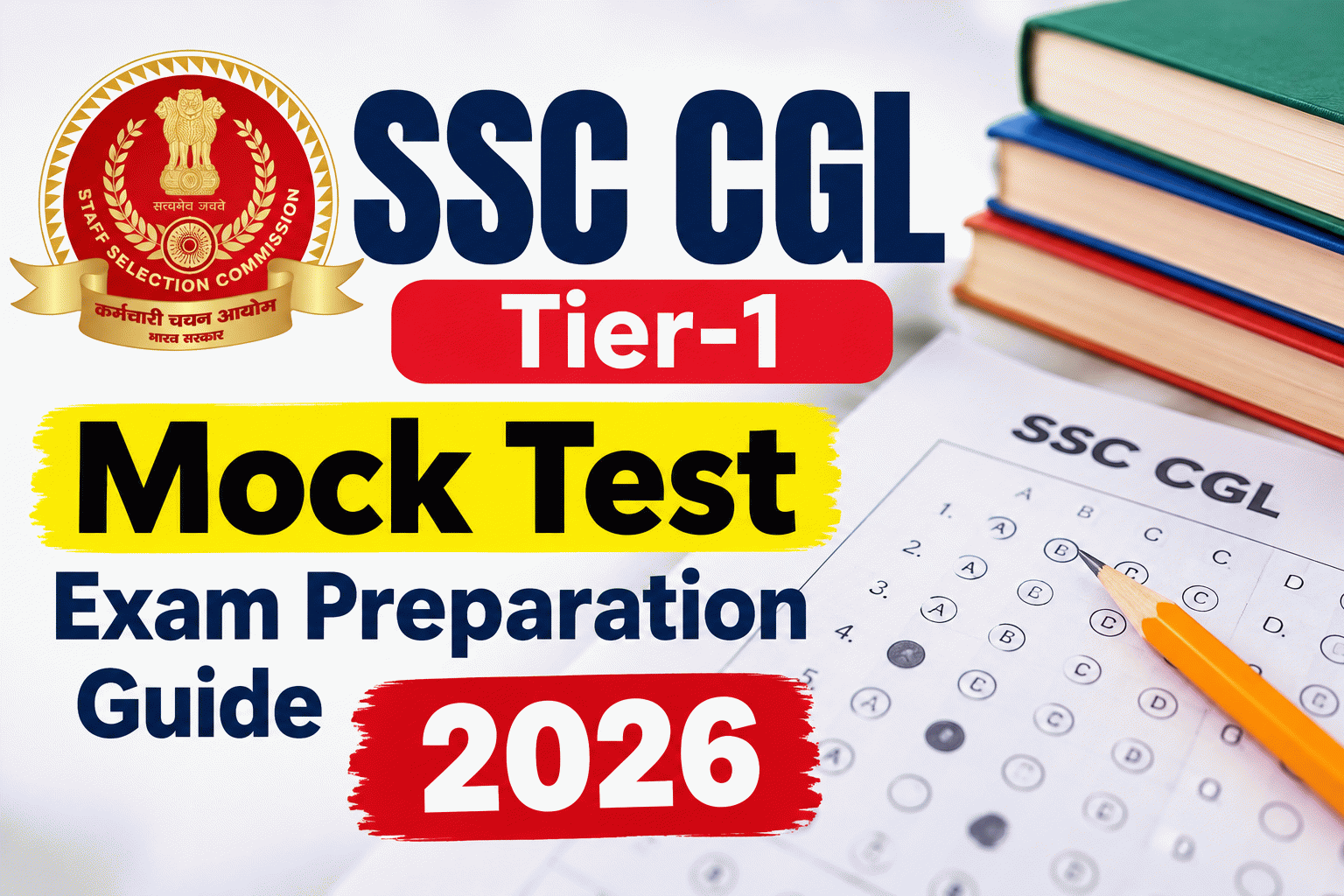
Put your preparation to the test with a full-length, exam-accurate mock test — 100 questions in the real 4-section pattern, a 60-minute timer, 0.5 negative marking, and a detailed section-wise review at the end so you know exactly where you’re losing marks. Take the Free SSC CGL Tier-1 Mock Test →
Make it a weekly habit at minimum, and ramp up to every alternate day as your exam date approaches. Review every wrong answer like it’s more valuable than ten right ones — it usually is.
A Realistic Timeline
If you’re starting from scratch, give yourself 6–8 months of consistent daily preparation to be genuinely exam-ready for both tiers. If you already have a graduate-level base in Maths and English, 4–5 months of focused mock-and-review practice can get you there. Either way, don’t wait until you “feel ready” to start taking mock tests — start early, track your section-wise scores over time, and let the data tell you where to focus next.
SSC CGL rewards patience and consistency far more than last-minute intensity. Build your basics properly, practice under real exam conditions often, and trust that steady daily effort compounds into a strong result.